
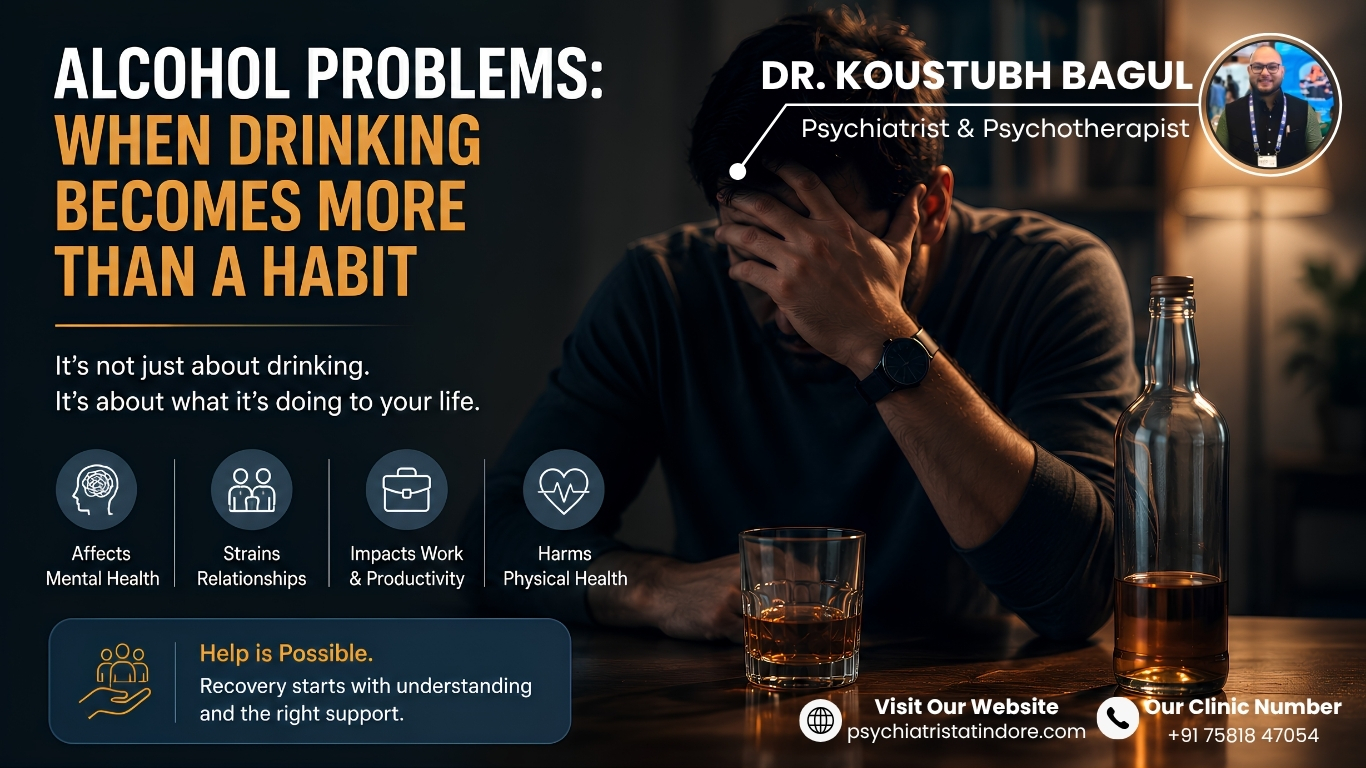
Most people have had a drink at a social gathering or to unwind after a long day. But for many, what starts as occasional drinking slowly becomes something they can’t control — something that begins affecting their health, relationships, work, and sense of self.
If you or someone you care about is drinking more than intended, feeling unable to stop, or facing problems because of alcohol — you are not alone, and you are not beyond help.
At Brain & Mind Neuropsychiatry Clinic, Indore, Dr. Koustubh Bagul works with individuals and families dealing with alcohol-related problems every day. The approach here is non-judgmental, medically sound, and focused on long-term recovery — not just short-term fixes.
What Are Alcohol Problems?
“Alcohol problems” is a broad term that covers a range of issues — from drinking too much too often, to full-blown Alcohol Use Disorder (AUD). It includes:
- Alcohol Abuse — drinking in a way that causes repeated harm (to health, work, or relationships) but without physical dependence
- Alcohol Dependence — when the body becomes physically reliant on alcohol; stopping causes withdrawal symptoms
- Alcohol Use Disorder (AUD) — the clinical diagnosis that encompasses both abuse and dependence on a spectrum from mild to severe
Dr. Koustubh Bagul at Brain & Mind Neuropsychiatry Clinic emphasizes that alcohol problems don’t always look like what we imagine. Many people functioning in jobs and families in Indore are quietly struggling with alcohol dependency — a reality that often goes unaddressed for years.
Signs and Symptoms of Alcohol Problems
Alcohol problems rarely announce themselves loudly. They creep in gradually. Here are the signs to watch for:
Behavioral Signs:
- Drinking more or for longer than you planned
- Repeated unsuccessful attempts to cut down or stop
- Spending a lot of time drinking, recovering from drinking, or thinking about alcohol
- Giving up hobbies, social activities, or responsibilities because of alcohol
- Continuing to drink even when it’s causing problems at home, work, or in relationships
- Drinking in situations where it’s physically dangerous — driving, operating machinery
Physical Signs:
- Needing more alcohol to feel the same effect (tolerance)
- Experiencing withdrawal symptoms when not drinking — shaking, sweating, nausea, anxiety, insomnia
- Drinking early in the morning to avoid withdrawal or “steady the nerves”
- Noticeable changes in weight, skin, and overall health
- Frequent blackouts or memory gaps
Psychological Signs:
- Intense cravings for alcohol
- Using alcohol to cope with stress, sadness, loneliness, or anxiety
- Feeling irritable, anxious, or depressed when not drinking
- Denial — minimizing or hiding how much one actually drinks
At Brain & Mind Neuropsychiatry Clinic, Indore, Dr. Koustubh Bagul conducts a thorough evaluation to understand where a person stands on this spectrum — because the right treatment depends entirely on an accurate picture.
How Alcohol Affects the Brain and Body
This is something many people underestimate. Alcohol isn’t just a social substance — over time, it is a toxin that causes serious, sometimes permanent damage.
On the Brain:
- Alcohol alters the balance of neurotransmitters, particularly GABA and dopamine, creating artificial calm and pleasure — which is precisely what makes it addictive
- Long-term use shrinks brain volume, impairs memory, damages decision-making, and can lead to conditions like Wernicke-Korsakoff Syndrome (a severe neurological disorder caused by alcohol-related thiamine deficiency)
- It worsens existing mental health conditions like depression, anxiety, and bipolar disorder — and can trigger them in people who had no prior history
On the Body:
- Liver: Fatty liver, alcoholic hepatitis, cirrhosis — liver damage is one of the most serious consequences of long-term alcohol use
- Heart: Irregular heartbeat, high blood pressure, increased risk of stroke and cardiomyopathy
- Pancreas: Alcoholic pancreatitis, which is extremely painful and potentially life-threatening
- Immune System: Weakened immunity, making the body more vulnerable to infections
- Gut: Chronic gastritis, ulcers, and poor nutrient absorption
- Cancer Risk: Long-term alcohol use is linked to increased risk of cancers of the mouth, throat, esophagus, liver, colon, and breast
What Causes Alcohol Problems?
There is no single reason why someone develops a problem with alcohol. It’s almost always a combination of factors:
1. Genetics and Family History
Alcohol use disorder has a significant hereditary component. If a parent or sibling has struggled with alcohol, the risk is meaningfully higher. Brain & Mind Neuropsychiatry Clinic always takes detailed family history into account during evaluation.
2. Mental Health Conditions
Depression, anxiety disorders, PTSD, and bipolar disorder are strongly linked to alcohol misuse. Many people in Indore and elsewhere begin drinking to manage emotional pain — what’s known as self-medication. Dr. Koustubh Bagul is careful to identify and treat co-occurring mental health conditions alongside alcohol dependency.
3. Trauma and Adverse Life Experiences
Childhood trauma, abuse, neglect, or a major loss can significantly raise the risk of developing alcohol dependency later in life.
4. Social and Environmental Factors
Peer pressure, social circles where heavy drinking is normalized, easy availability of alcohol, and cultural expectations around drinking all play a role. In many parts of India — including Indore — social drinking is increasingly normalized, making it harder for people to recognize when things have gone too far.
5. Stress and Lifestyle
Work pressure, financial stress, relationship difficulties, and a lack of healthy coping mechanisms often push people toward alcohol as a release valve. Over time, what feels like a solution becomes the problem itself.
6. Early Onset of Drinking
People who begin drinking in adolescence are significantly more likely to develop alcohol use disorder as adults.
The Reality of Alcohol Withdrawal
Unlike many substances, alcohol withdrawal can be medically dangerous — even life-threatening in severe cases. Symptoms of withdrawal include:
- Tremors (shaking hands)
- Profuse sweating and rapid heart rate
- Severe anxiety and irritability
- Insomnia
- Nausea and vomiting
- In serious cases: seizures and delirium tremens (DTs) — a severe state involving confusion, hallucinations, and dangerous changes in body temperature and blood pressure
Attempting to stop drinking abruptly without medical supervision can be extremely dangerous. If you or someone you love is dependent on alcohol and wants to stop, please contact Brain & Mind Neuropsychiatry Clinic at +91 75818 47054 before attempting withdrawal. Medical detoxification under the supervision of Dr. Koustubh Bagul is the safest, most effective first step.
Treatment for Alcohol Problems at Brain & Mind Neuropsychiatry Clinic, Indore
Recovery from alcohol dependency is absolutely possible. Dr. Koustubh Bagul uses a comprehensive, individualized approach that addresses not just the drinking — but everything underneath it.
Step 1: Assessment and Diagnosis
The first step at Brain & Mind Neuropsychiatry Clinic is a thorough evaluation — understanding the pattern of alcohol use, its impact, any co-occurring mental health conditions, and the person’s overall medical health. There is no judgment here. The goal is clarity, so the right plan can be built.
Step 2: Medical Detoxification
For those who are physically dependent on alcohol, a supervised detox is essential. Dr. Koustubh Bagul manages this process carefully — using medications to prevent withdrawal complications, ensure safety, and make the process as comfortable as possible.
Step 3: Medication-Assisted Treatment (MAT)
Several medications have strong evidence in supporting alcohol recovery:
- Naltrexone — reduces cravings and the rewarding effect of alcohol
- Acamprosate — helps the brain stabilize after stopping alcohol; reduces the discomfort of early abstinence
- Disulfiram — creates an unpleasant reaction if alcohol is consumed; used as a deterrent
- Medications for co-occurring conditions — treating underlying depression or anxiety is often essential to sustainable recovery
Step 4: Psychological Therapy
Medication alone is rarely enough. Therapy addresses the thoughts, patterns, and emotional wounds that fuel alcohol use.
- Cognitive Behavioral Therapy (CBT): Identifies triggers and builds healthier coping responses
- Motivational Enhancement Therapy (MET): Strengthens the person’s own motivation and commitment to change
- Relapse Prevention Therapy: Teaches practical strategies to handle cravings and high-risk situations
- Family Therapy: Alcohol problems affect the entire family — Brain & Mind Neuropsychiatry Clinic also supports families through the recovery process
Step 5: Lifestyle Support and Relapse Prevention
Long-term recovery involves rebuilding a life where alcohol no longer has a central role. Dr. Koustubh Bagul works with patients on sleep, nutrition, physical activity, social support, and structured daily routines — because a stable, meaningful life is the strongest protection against relapse.
What About the Family?
Alcohol problems don’t happen in isolation. Families — spouses, parents, children — are often deeply affected. Living with someone who has an alcohol problem can cause anxiety, exhaustion, emotional trauma, and a constant sense of walking on eggshells.
Brain & Mind Neuropsychiatry Clinic in Indore extends support to families as well. Dr. Koustubh Bagul helps families understand the condition, set healthy boundaries, and navigate the difficult emotions that come with loving someone who is struggling.
If you are a family member wondering how to help someone you love — reaching out to Brain & Mind Neuropsychiatry Clinic is a good first step, even if your loved one is not yet ready to seek help themselves.
Myths About Alcohol Problems — Addressed
Myth: “It’s just a habit, not a disease.”
Alcohol Use Disorder is a recognized medical condition with biological, psychological, and social dimensions. Dr. Koustubh Bagul at Brain & Mind Neuropsychiatry Clinic treats it with the same clinical seriousness as any other chronic health condition.
Myth: “They just need more willpower.”
Willpower alone is rarely enough — because alcohol physically changes the brain’s reward and decision-making systems. Treatment, not willpower, is what produces sustainable recovery.
Myth: “They have to hit rock bottom before they can get help.”
Absolutely not. The earlier someone seeks help, the better the outcomes. Brain & Mind Neuropsychiatry Clinic sees patients at every stage — and early intervention makes a genuine difference.
Myth: “Only men have alcohol problems.”
Women are equally affected, though they often develop dependency faster and face different social stigmas around seeking help. Dr. Koustubh Bagul offers a sensitive, confidential environment for patients of all backgrounds.
Myth: “Once an alcoholic, always an alcoholic.”
Recovery is real and it lasts. Many people treated at Brain & Mind Neuropsychiatry Clinic, Indore go on to lead full, healthy, meaningful lives — without alcohol.
Frequently Asked Questions (FAQs)
Q: How do I know if I have a drinking problem or if I’m just a social drinker?
A: Ask yourself honestly — do you find it difficult to stop after a drink or two? Do you drink to cope with emotions? Has drinking caused problems in your life? If you answered yes to any of these, a consultation with Dr. Koustubh Bagul at Brain & Mind Neuropsychiatry Clinic would be worthwhile.
Q: Is it safe to stop drinking on my own?
A: If you drink heavily or daily, stopping abruptly without medical supervision can be dangerous and in some cases life-threatening. Please contact Brain & Mind Neuropsychiatry Clinic at +91 75818 47054 before attempting to stop. Medical detox under Dr. Koustubh Bagul’s care is the safest route.
Q: Will my information be kept confidential?
A: Absolutely. Brain & Mind Neuropsychiatry Clinic maintains complete confidentiality. Your struggle is between you and Dr. Koustubh Bagul — nothing else.
Q: Can alcohol use disorder be treated without going to a rehabilitation centre?
A: Yes, in many cases. Depending on the severity, outpatient treatment at Brain & Mind Neuropsychiatry Clinic, Indore — including medical management and therapy — can be highly effective. Dr. Koustubh Bagul will assess what level of care is most appropriate for your situation.
Q: How long does treatment take?
A: There’s no single timeline. Some people stabilize within weeks; others benefit from longer-term support. Recovery is a journey, and Brain & Mind Neuropsychiatry Clinic supports patients at every step — not just the beginning.
Q: My family member refuses to get help. What can I do?
A: This is heartbreakingly common. You can come in yourself to speak with Dr. Koustubh Bagul at Brain & Mind Neuropsychiatry Clinic — there are strategies to help you support your loved one while also protecting your own wellbeing.
Q: Does alcohol use disorder always come with other mental health problems?
A: Not always, but very often. Depression, anxiety, and trauma commonly co-occur with alcohol dependency. Dr. Koustubh Bagul screens for and treats these conditions as part of comprehensive care at Brain & Mind Neuropsychiatry Clinic.
Q: Is online consultation available?
A: Yes. You can reach Brain & Mind Neuropsychiatry Clinic at +91 75818 47054 or visit psychiatristatindore.com to know more and book a consultation.
You Don’t Have to Face This Alone
Alcohol problems are not a character flaw. They are not a sign of weakness. They are a medical condition — one that responds well to the right care, at the right time, from the right hands.
Dr. Koustubh Bagul — Psychiatrist & Neuropsychiatrist, Indore
📍 First Floor, Madhur View Complex, Bhawarkua Main Rd, Indore
📞 +91 75818 47054
🌐 psychiatristatindore.com
Take the first step. Make the call. Recovery is possible — and Brain & Mind Neuropsychiatry Clinic will walk every step of it with you.

